Eye Floaters
There are two types of fluid in the eye: the aqueous and vitreous humors. The aqueous humor is the clear fluid in the front of the eye, filling the outer chamber that lies between the iris and the cornea. This fluid is secreted from the ciliary body, then percolates around the lens, flushes the cornea and the iris, and finally exits through the angle of the eye that can become blocked in glaucoma.
The vitreous humor is gelatinous in texture. This fluid fills all of the inside of the eye behind the lens. It develops before birth to support the retina and allow blood vessels to nourish the lens during fetal life. Occasionally, bits of cells remain in the vitreous humor after birth and may float around when the vitreous becomes more liquefied in later life. These nuisances are called eye floaters, and occur in most people after the age of 50. Nearly everyone has a few floaters sometime in their lives, and they are usually nothing to be concerned about.
Posterior Vitreous Detachment (PVD)
Frequently people develop a sudden, very large floater, which looks like a cobweb or an insect. Initially they will swat at it only to realize that the floating object is in the eye. A PVD represents a contraction of the collagen fibers in the vitreous humor, which detaches the outer layer of the vitreous from the adjacent surface of the retina. 98% of the time the PVD detaches from over the optic nerve, the blind spot in the eye, and appears suddenly as it floats in front of the center of vision (the macula).
PVD will often be accompanied by a crescent shaped flashing light, which is usually seen in the dark. I make this distinction because the light flash associated with a retinal tear or detachment tends to be brighter and more constant (see below). The flashing light usually disappears in ten to fourteen days although may occur even longer because the peripheral vitreous is still sticking on the retina. The actual “floater” tends to shrink and drop out of sight except when viewing highly illuminated paper or scenes. None the less, it is wise to see your eye care physician to be certain that the PVD is not associated with a retinal tear or detachment.
Retinal Tear and Retinal Detachment
A new floater with or without flashing lights may be caused by a tear in the retina. Many times this occurs because the peripheral vitreous contracts, as opposed to the posterior vitreous, which is on the rigid optic nerve. A retinal tear may also be associated with a recent injury or an incident that happened in the past.. Typically, there will be cells in the vitreous, which come from the underlying pigment or blood can only be detected by a dilated optometric exam.
A retinal detachment may occur spontaneously or subsequent to a tear in the retina. Fluid in the vitreous can pull the tear further and pull off the retina. A retinal detachment is a medical emergency because it often will progress quickly and affect much of the vision. Rapid diagnosis will allow one of the following treatments:
- Argon laser photocoagulation of the tear.
- Cryo treatment of a larger tear.
- Intraocular administration of an air or gas bubble to blow the retina back into position so that the above treatments can be administered.
- Removing the vitreous body in a procedure called a vitrectomy and then fluid, air, gas, or even silicone oil can be placed.
- Occasionally a retinal buckle can be placed around the globe to insure better fixation of the wounded retina to the outer coats of the eye.
So you can see that early diagnosis of flashes and floaters is imperative so that a retinal tear or detachment can be ruled out or identified.
Epi-Retinal Membrane
Degeneration of the vitreous body, perhaps due to long term solar exposure, can lead to unusual events. One such item is the development of a fibrous membrane over the macula (the center of the retina), which causes distortion of vision. Other names for it are cellophane maculopathy and retinal wrinkling. Mild forms will be recognized as slight distortion of letters and cause some difficulty with distance vision. More significant scarring causes extreme distortion causing an inability to read with the affected eye. At this point a membrane peeling retinal procedure is the only treatment. Vitamins and herbs cannot alter the course of this disorder.
Macular Hole
Sometimes the vitreous adheres to the macula and both contract. This causes the tissue to be peeled off in a smooth circular fashion much like what you would see if a pencil poked a hole in a piece of paper. This may be related to other eye diseases or even trauma. The only treatment is retinal repair with an intraocular gas bubble. The sooner this is detected the better.
Retinitis Pigmentosa (RP)
Retinitis Pigmentosa is a peripheral retina degeneration with a heredity pattern.This disease can begin as early as the teens or as late as the fifties. Characteristic pigmentation changes in the peripheral retina and decreased vision at night are the early findings. Lastly, central vision can become involved and very few people may lose most of their vision.
There have been several studies that have demonstrated nutritional remedies for this disorder. First, and foremost, the omega-3 fatty acid DHA. Referred to in the section on macular degeneration, DHA is found in algae and cold-water fatty fish and helps rebuild and maintain retinal cell membranes. 500 mgs of DHA, taken with a meal, and 400 IU of vitamin E or a multivitamin twice a day is recommended. For more information about DHA see my book, The DHA Story.
10 mg of Lutein daily has been demonstrated to slow the progress of RP. Lutein is a member of the carotenoid family which includes vitamin A and is found in high levels in the macula. Since it is fat-soluble it needs to be taken with a meal.
A good multivitamin preferably in capsule form twice daily is recommended along with an additional 10,000 IU of vitamin A and 400 IU of vitamin E (taken at a separate meal from the vitamin A).
Some nutritionists recommend that a digestive enzyme taken at the end of each meal will help to fully digest a meal and make the nutrients more available for the liver. This is because sunlight is the major contributor to retinal degeneration. Herbal remedies that have improved digestion are recommended by my herbalist colleague, Alan Tillotson, PhD. Visit his website or email him directly for consultations.
Wearing sunglasses outdoors, even on cloudy days, is imperative. This is because sunlight is the major contributor to retinal degeneration.
Eye Complex CS
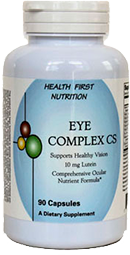
total body, multi-
vitamin formulated
by Dr. Robert Abel
for patients unable
to get essential eye
nutrients through
diet alone.
"Dr. Robert Abel is a healer for
the 21st century."
Mehmet Oz, M.D. (Dr. Oz)
Now Available
to the Public
- 23 Essential Nutrients
- More Lutein
- NO Copper
- Normal Zinc Levels
- Money-Back Satisfaction
Guarantee
Discussions with Dr. Abel

The Eye Care Revolution
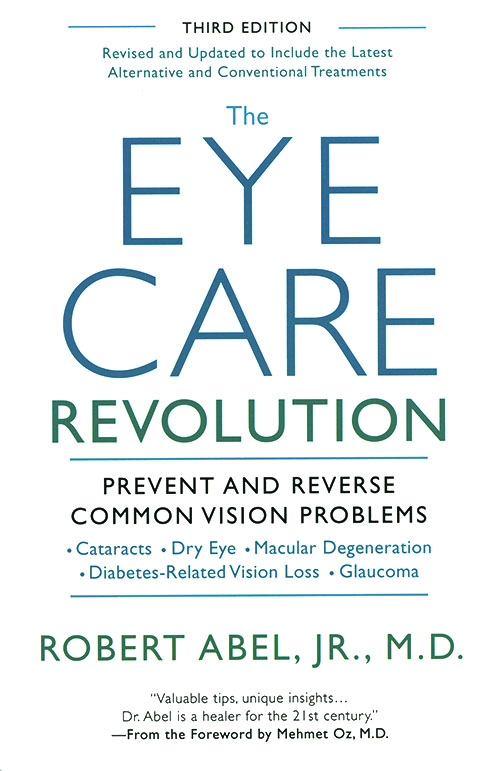
Over 100,000 copies sold! From high-tech laser treatments to centuries-old Asian remedies, Dr. Abel's authoritative guide explains natural and conventional methods to prevent and even reverse many common vision disorders.
Dr. Abel’s Children’s Books

Dr. Abel’s Mystery Novels


Follow Us